The books, globe, rolled documents in the sitter’s left hand, quill in his right, and stack of papers on the desk all signal a man of serious intellect and scholarly pursuit. This portrait shows William Roscoe (1753–1831), a Liverpool banker, lawyer, historian, art collector, poet, botanist, and writer. More importantly, he was one of Britain’s earliest and most dedicated abolitionists.
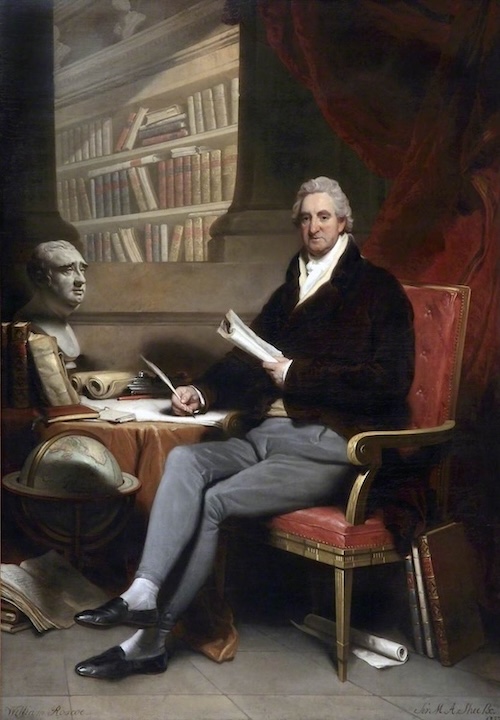
What caught my eye in this canvas, however, is the bust on the table, tucked behind leather-bound volumes and scrolls of parchment. The marble gaze of Charles James Fox (1749–1806) stares steadfastly at Roscoe, who appears lost in thought as he looks toward the artist.
Like Roscoe, Fox was a committed abolitionist. As a prominent Whig leader in the House of Commons, he wielded real influence to steer Britain toward outlawing the slave trade across its empire.

On June 10, 1806, as Foreign Secretary, Fox proposed a resolution declaring the African slave trade “contrary to the principles of justice, humanity, and sound policy.” Parliament approved it overwhelmingly on June 24, committing both Houses to swift abolition measures.
The Slave Trade Act passed in March 1807, six months after Fox’s death on September 13, 1806. Yet he died knowing his efforts had paved the way for this monumental shift in British policy and human rights.
Charles James Fox was among the most vivid personalities of Georgian England—an era rich with eccentrics. His disheveled appearance gave little hint that he descended from King Charles II through an illegitimate line (Charles Lennox, 1st Duke of Richmond). His uncle, the elegant 3rd Duke of Richmond, shared Fox’s Whig principles and opposition to George III, including support for American Patriots during the Revolution.
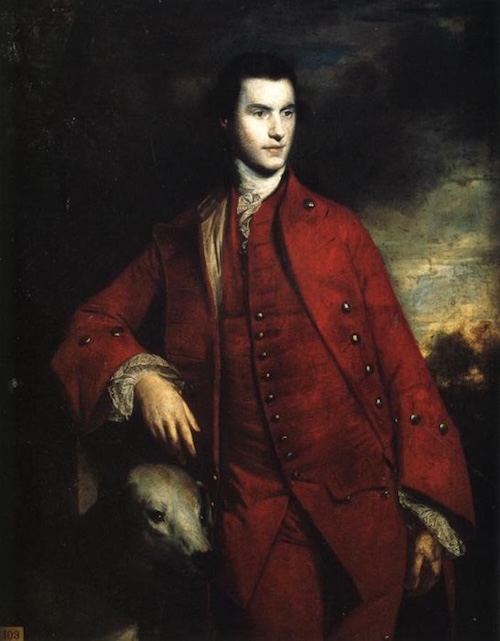
A notorious gambler and heavy drinker, Fox abandoned his earlier womanizing ways by marrying Elizabeth Armistead (1750–1842), a former courtesan who had once been linked to the Prince of Wales (later George IV). Alcoholism ravaged his health, leaving him deeply in debt when he died at 57. He was buried with honors in Westminster Abbey.

About the Artist
Portrait painter Sir Martin Archer Shee (1769–1850) was born in Dublin on December 23, 1769. After studies at the Royal Dublin Society’s schools, he moved to London and enrolled at the Royal Academy. Following Sir Thomas Lawrence’s death in 1830, Shee succeeded him as President of the Royal Academy and was promptly knighted by William IV.
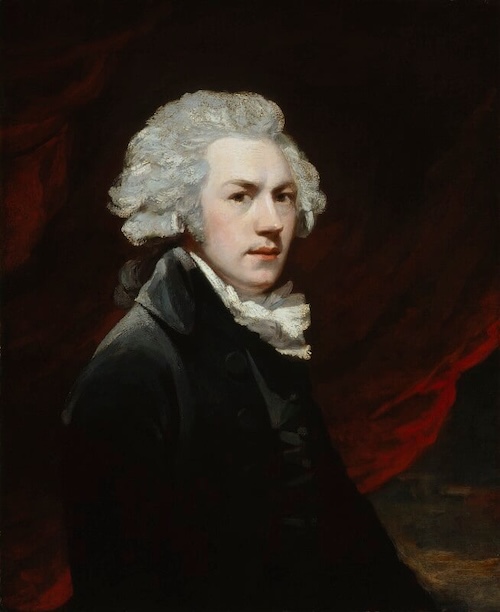
Beyond his sought-after portraits, Shee published poetry and novels. Declining health led to his retirement in 1845; he relocated to Brighton, where he died in 1850.
Discover more from Art*Connections
Subscribe to get the latest posts sent to your email.
 Art*Connections