In the painting An Incident in the French Revolution by Walter William Ouless, we see an elderly gentleman with downcast eyes, who is surrounded by soldiers clutching rifles with affixed bayonets. A frightened young woman clutches his arm, as they are led from their cell. She is Marie-Maurille de Sombreuil, and the man at her side is her father, Lieutenant General Charles François de Virot de Sombreuil. When he was imprisoned on August 16, 1792, for defending the Tuileries Palace against the insurrectionists, Marie-Maurille insisted that she be locked up with him.

Louis XVI and Marie Antoinette had been living at the Tuileries for three years, since October 1789. For most of that time, they were under house arrest. After negotiating with the National Constituent Assembly for the establishment of a constitutional monarchy in France, the King had reluctantly acceded to the terms. Nevertheless, the radical Jacobins continually used propaganda to turn public sentiment against the King and Queen.
On the morning of October 5, there was unrest in the streets of Paris. The mood of the city had been volatile, ever since the storming of the Bastille on July 14, 1789, had ignited the Revolution’s first violent flames.
In order to breach the Bastille, the rebels needed weapons, so they demanded access to the cannons and muskets in the arsenal stores of Les Invalides. This was a care home for veteran pensioners, who were no longer fit for active duty in the armed forces. Its governor was 64-year-old Lieutenant Colonel Sombreuil. With no soldiers under his command to defend the facility, Lieutenant Colonel Sombreuil offered no resistance. This probably saved his life.

On this particular day in October, women shopping at the market were unable to contain their fury at the high price of bread. Goaded by insurgent agitators, hundreds of men joined in the disturbance and a riot nearly ensued. The mob was unwittingly steered by firebrands to advance to Versailles.
It didn’t take much prodding to convince the aggrieved rabble to loot the city armory and begin the 13-mile march to the southwest. When the protestors arrived in Versailles about six hours later, they were met by a large crowd that had already assembled there. Heavily armed, the angry demonstrators besieged the Palace.
The following day, the throng forced the King and Queen of France to return to Paris with them. They preferred to have the royal family close, so that they could keep an eye on them.
On May 20, 1791, Sombreuil was promoted to lieutenant general. He was on duty and participated in the defense against the raid on the Tuileries Palace on August 10, 1792. Six hundred of the King’s Swiss Guards and 300-400 revolutionaries died in the battle. In the end, the monarchy was overthrown. The King and Queen were arrested on August 13, and imprisoned at the Temple, a medieval fortress. Lieutenant General Sombreuil was arrested on August 16.

The massacres in Paris began on September 2. The floors of the Abbaye Prison were soaked in the blood of butchered inmates, when the guards came for Lieutenant General Sombreuil. His daughter pleaded for mercy, as they were being led to face the judges and a certain sentence of death. Her cries were heeded, and her father’s life was spared.
Lieutenant General Sombreuil remained in prison until he was sentenced to death on June 17, 1794, accused of counter-revolutionary conspiracies, including plots against the Committee and a prison uprising. The 69-year-old man was guillotined that same day.
Ironically, two of the revolution’s architects were killed before Lieutenant General Sombreuil, as the ideology of the radicals shifted and the zealots turned against each other in their quest for power. Jean-Paul Marat, a journalist and propagandist, was assassinated on July 13, 1793, by a disillusioned Girondin sympathizer, Charlotte Corday. This young woman believed that Marat was too extreme and needed to die. She was executed four days later for her crime. Georges Danton, who rose up from obscurity to become Minister of Justice, was sent to the guillotine on April 5, 1794.

Just six weeks after the killing of Lieutenant General Sombreuil, the National Convention turned on one of the most influential proponents of their revolution. As punishment for his excesses in the Reign of Terror, Maximilien Robespierre was guillotined without a trial on July 28, 1794.

About the Artist
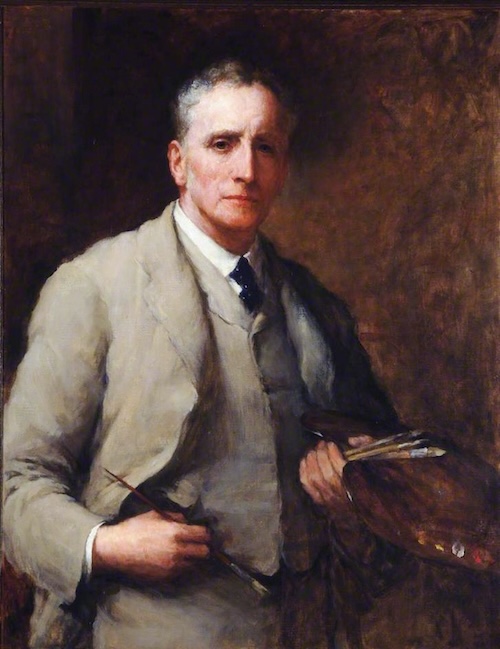
When Walter William Ouless (1848-1933) painted An Incident in the French Revolution, he drew on royalist lore to humanize the victims of the Revolution’s brutality. The Victorian-era artist was born on September 21, 1848, in St. Helier, Jersey. He moved to London in 1864, after completing his studies at Victoria College. His first exhibit at the Royal Academy was in 1869.
Discover more from Art*Connections
Subscribe to get the latest posts sent to your email.
 Art*Connections