“Don’t stop. Keep moving. There’s nothing to see here.”
You look away and continue about your business. But who are you kidding? If there was nothing to see, why did you drop your gaze?
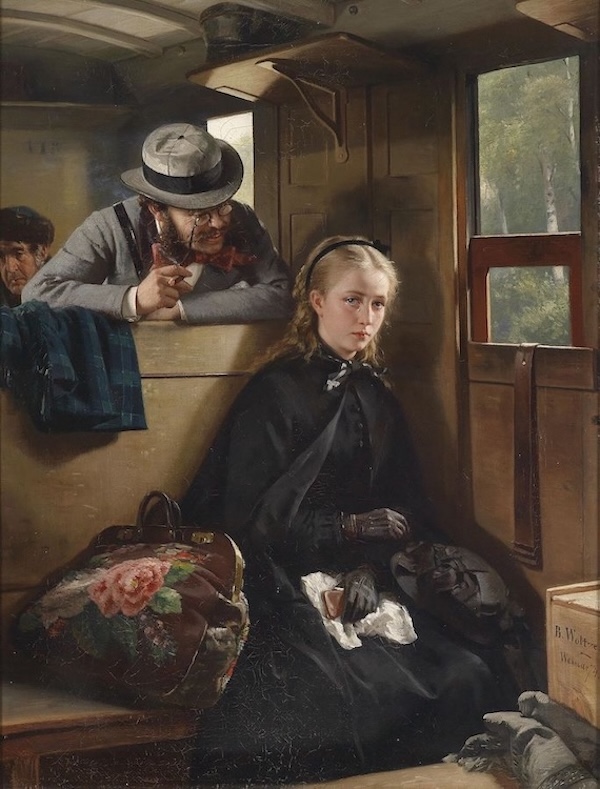
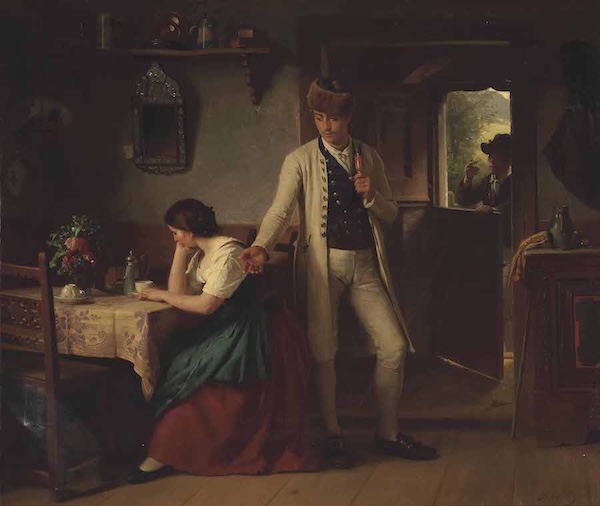
Genre artist Berthold Woltze (1829-1896), who was born on August 24, 1829, in Havelberg, Kingdom of Prussia, often portrayed scenes that leave us with questions. Should we turn away or look more deeply?
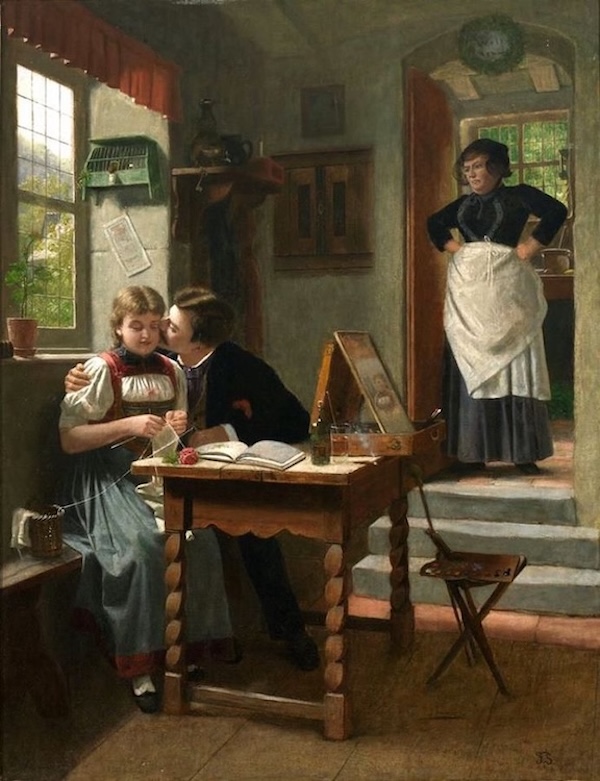
Woltze’s intriguing depictions are referred to as “problem paintings.” When you see one, you feel like you have stumbled into a scene with some unknowable, emotionally charged backstory.
A stark example is Der lästige Kavalier (The Irritating Gentleman). In this image, a lecherous man is pestering a girl who is traveling solo on a train. She appears to be in mourning. In the background, another passenger is uncomfortably aware of what is happening, yet he turns his eyes away. And we, the viewers, share his discomfort, but we stare, puzzling over what is going on.
Speaking of men behaving badly, I happened to come across a quote from Time Regained, the final volume of In Search of Lost Time (or Remembrance of Things Past) by Marcel Proust. It stopped me cold.
A woman one loves rarely suffices for all our needs, so we deceive her with another whom we do not love.
Une femme qu’on aime suffit rarement à tous nos besoins et on la trompe avec une femme qu’on n’aime pas.
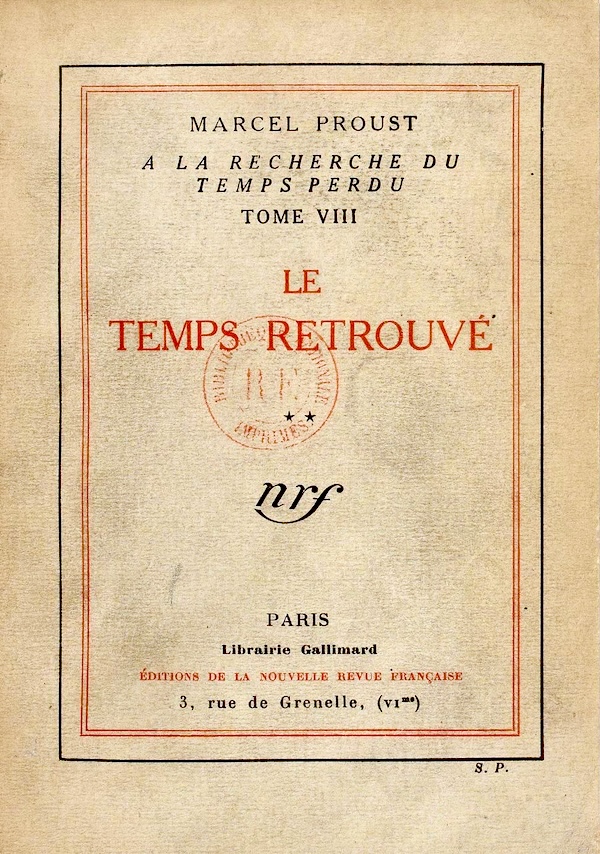
This universal truth, so simply stated, rings as true today as it did when Proust’s words were published about 100 years ago. But of course, human nature has been around much longer than that. What Proust observed is true now, was true then, and no doubt it was true two millennia before that.

Another inconvenient quirk of human nature enables us to justify our own bad behavior towards someone by rationalizing that somehow that person deserved it. If my wife was meeting my needs, I would not be looking outside the marriage for intimacy. By that reasoning, the woman practically forced her husband to commit adultery. It’s her fault that he broke his vow to her (and perhaps one of the 10 commandments to boot).
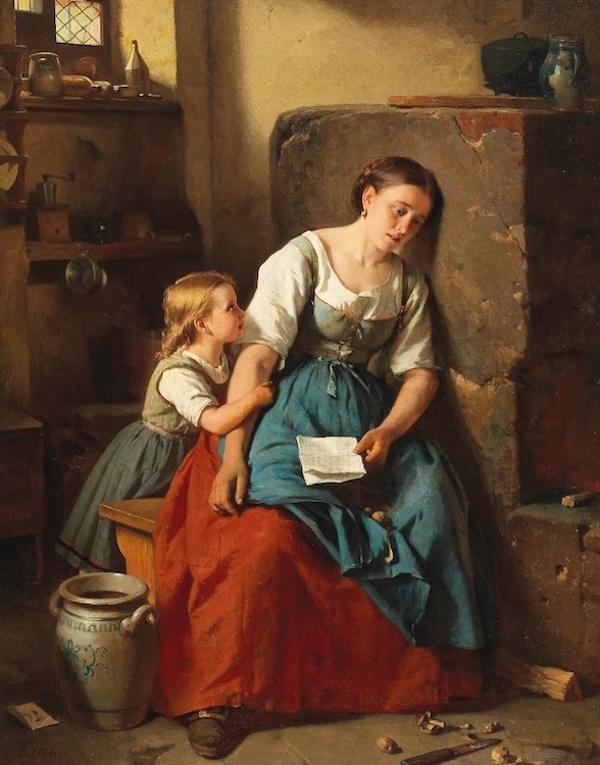
Bear in mind that Mr. Proust neglected to mention that there is a mitigating factor, which endows us with the ability to act with integrity or at least to avert a transcendental train wreck. I’m talking about free will. This is what enables us, even obligates us, to modulate our behavior, especially when we cannot rely on instinct to lead us to the honorable choice.
In Proust’s novel, an involuntary memory connects the narrator to recollections about his youth. The incident behind the sensory experience that opened the floodgates was eating a madeleine dunked in tea. A young woman named Susie Morris told me about this many years ago, when I worked in a coffee store in Berkeley’s Gourmet Ghetto.
Susie had recently begun a wholesale madeleine baking business. We first met when she accompanied her husband Don one afternoon on his delivery route. Their VW van pulled up to the curb, the two got out, and then they came into the store to drop off our weekly order of madeleines. Don introduced Susie to me. An aspiring opera singer, Susie explained that she had learned to bake these wonderful little shell-shaped sponge cakes while living in France, studying music.
Don and Susie’s hard work paid off. They built Donsuemor into a thriving business, and Susie went on to pursue her passion for singing.
Throughout the years that I worked in the store, I started every morning with a cup of freshly brewed coffee and a madeleine. Certain memories stick with you. When it involves a treat like a madeleine, I’d put that in the column under the heading “Blessings.”
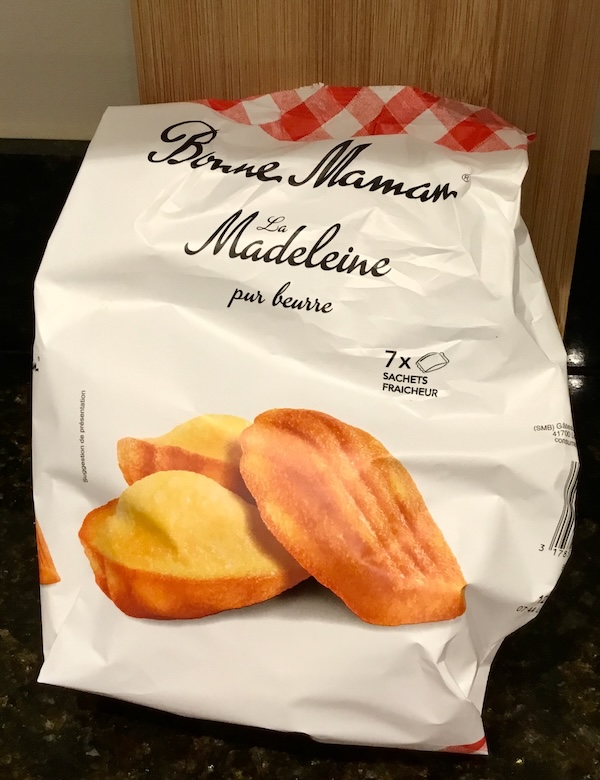
On my last trip to England, I was happy to see Bonne Maman madeleines, imported from France, on the shelf at Waitrose, which was a fifteen-minute walk from my apartment in York. To this day, on the rare occasions when I indulge my love of madeleines, I still compare them to the ones that Susie baked. I have yet to find one that is any better.
You can’t predict when you’ll experience a sensory connection. If you put your best energy into building treasured moments with the people you cherish, you’ll have no regrets. Choose a life without deception, so when you are hit with a torrent of involuntary memories, your heart will surge with joy.
Discover more from Art*Connections
Subscribe to get the latest posts sent to your email.
 Art*Connections